

Skip to content

Cart

Your cart is empty

Continue shopping
The therapeutic window · Five wavelengths

Not all light is created equal.

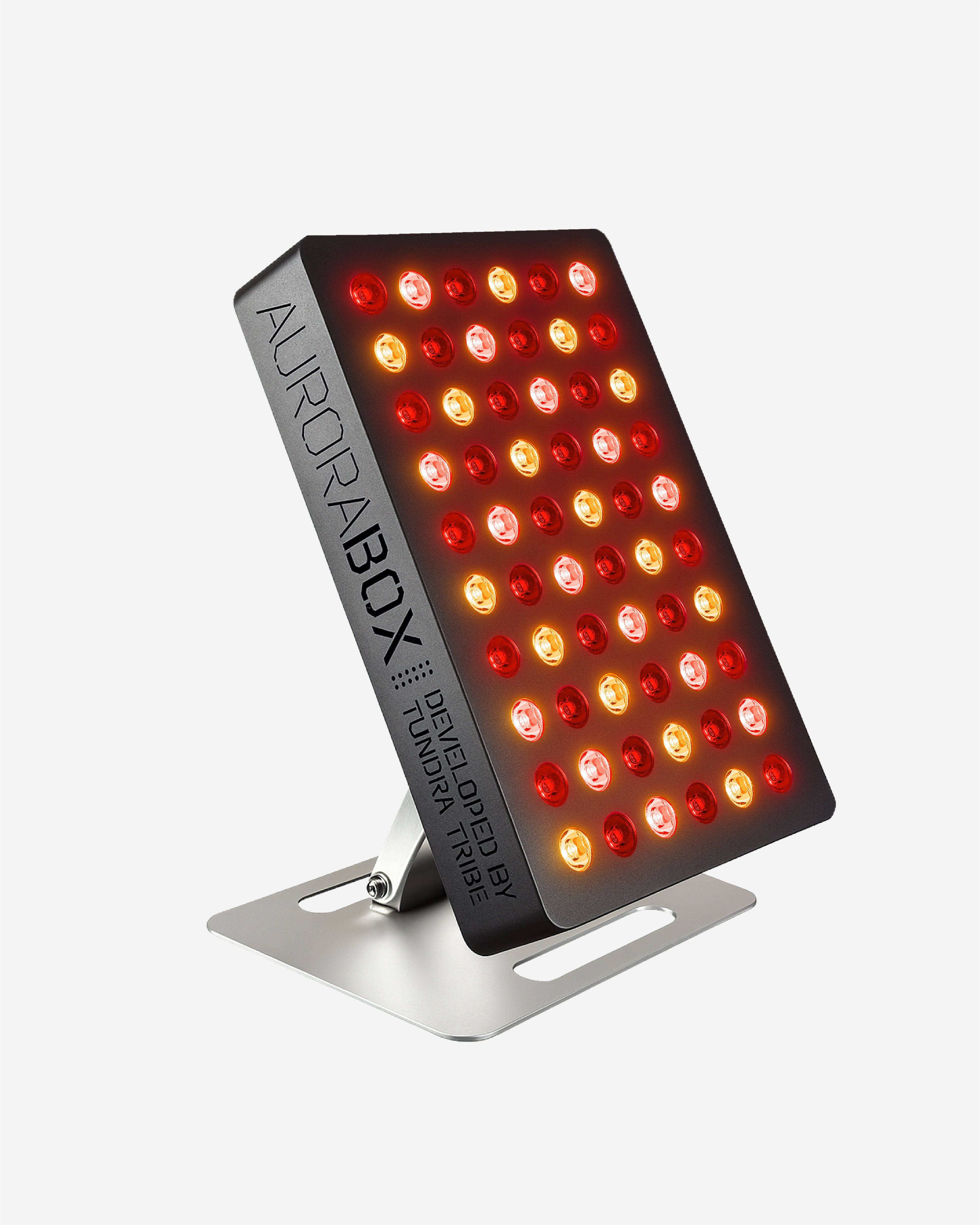
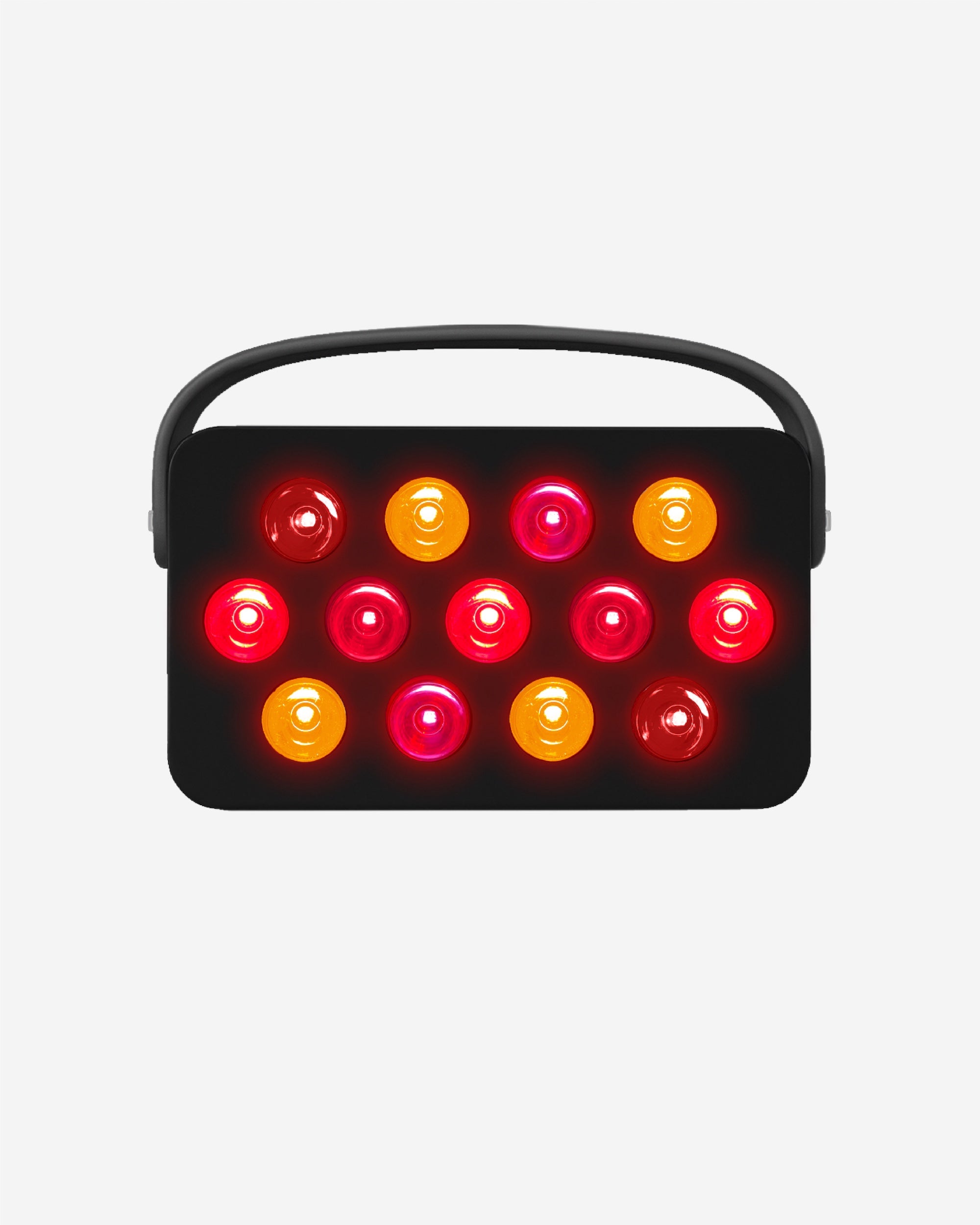
Visible light is mostly wasted on therapy. UV damages. Blue disrupts. Only a specific slice of red and near-infrared light actually reaches mitochondria and does useful work there. The AuroraBox platform delivers five of those wavelengths — each with its own penetration depth, target tissue, and decades of published research.

Currently five wavelengths. Additional therapeutic bands in development for the next platform release.

5
Therapeutic wavelengths
340mm
Tissue penetration range
4,000+
Published PBM studies
Spectrum Explorer
Click any wavelength tick · hover to explore
400 nm 500 nm 600 nm 700 nm 800 nm 900 nm
Violet Blue Green Yellow Orange Red Near-infrared
630nm
AuroraBox wavelength
Surface red · collagen & skin
First band absorbed by cytochrome c oxidase. Reaches upper dermis. Primary wavelength for skin collagen, fibroblast activation, and surface wound healing.
Scroll to explore each wavelength
The five · AuroraBox wavelengths

Each wavelength, what it does.

Every wavelength below is part of every current AuroraBox panel. Same platform, five bands working together — each one tuned to a different depth and tissue.

630nanometres
Surface red · visible

The collagen wavelength.

First band absorbed by cytochrome c oxidase. Reaches the upper dermis where fibroblasts live. The wavelength doing most of the work when you see “red light for skin” anywhere online.

AuroraBox band 01
Penetration
3–5 mm
Primary target
Dermal fibroblasts
Visibility
Visible red
CCO absorption
Peak 01 of 2
Tissue penetrationEpidermis · dermis
0 mm · Skin2 mm6 mm · Muscle40 mm · Deep
Primary use cases
Skin collagen density — the foundational use case with the strongest clinical trial data.
Anti-aging & wrinkle depth — RCT evidence for measurable improvement over 8–12 weeks of consistent use.
Surface wound healing & post-procedure recovery — accelerated re-epithelialization.
Inflammatory acne support — pairs well with standard care.
Representative studies
Red light thickened collagen density in 30 sessions.
Wunsch A, Matuschka K. · Photomed Laser Surg · 2014
RCT · N=136
Comprehensive review of PBM in dermatology.
Avci P et al. · Semin Cutan Med Surg · 2013
Clinical review
Combines with 660 nm for the complete red-band skin protocol.
See in Evidence Library
660nanometres
Deep red · visible

The vascular wavelength.

Penetrates slightly deeper than 630 nm. Reaches deeper fibroblasts and microvasculature. Heavily studied for hair follicle activation and the surprising “pre-conditioning” effect against UV damage.

AuroraBox band 02
Penetration
4–6 mm
Primary target
Deep dermis · follicles
Visibility
Visible red
Signature effect
Photoprevention
Tissue penetrationDeeper dermis · follicles
0 mm · Skin2 mm6 mm · Muscle40 mm · Deep
Primary use cases
Hair follicle activation — adjacent evidence from the 655 nm hair regrowth RCT.
UV photoprevention — pre-conditioning skin before sun exposure reduces damage markers.
Deeper tissue inflammation — reaches beyond surface capillaries.
Pairs with 630 nm for complete red-band dermal coverage on the AuroraBox platform.
Representative studies
Red light before sun exposure reduced UV damage.
Barolet D et al. · J Invest Dermatol · 2009
Split-body controlled
Visible red light regrew hair in androgenetic alopecia.
Lanzafame RJ et al. · Lasers Surg Med · 2013
Sham-controlled RCT
The hair regrowth evidence at ~655 nm maps directly to this band.
See in Evidence Library
810nanometres
Near-infrared · invisible

The brain wavelength.

Second major CCO absorption peak. First of the near-infrared bands. The wavelength cited in the landmark Nature paper on gamma entrainment, and the one most studied for transcranial applications and mood research.

AuroraBox band 03
Penetration
Up to 30 mm
Primary target
Muscle · cortex
Visibility
Invisible
CCO absorption
Peak 02 of 2
Tissue penetrationDeep tissue · superficial cortex
0 mm · Skin2 mm6 mm · Muscle40 mm · Deep
Primary use cases
Transcranial PBM — cognitive research, gamma entrainment, the 40 Hz Alzheimer’s work.
Mood support — frontal cortex PBM for treatment-resistant depression pilots.
Deep tissue repair — entry band for musculoskeletal and joint applications.
TMJ & facial pain — sham-controlled RCT evidence at this exact wavelength.
Representative studies
MIT scientists reduced Alzheimer’s plaques with flickering light.
Iaccarino HF, Tsai LH et al. · Nature · 2016
Landmark study
Near-infrared light crosses the skull.
Hamblin MR. · BBA Clinical · 2016
Transcranial review
NIR to the forehead improved major depression.
Cassano P et al. · Photomed Laser Surg · 2015
Open-label pilot
The entry point of near-infrared therapy — widest range of applications.
See in Evidence Library
830nanometres
Deep near-infrared · invisible

The clinical workhorse.

The wavelength you’ll find in every serious clinic. Reliable depth, well-studied dosing, and the band behind the most striking findings in the PBM literature — including the Hashimoto’s thyroiditis results.

AuroraBox band 04
Penetration
Up to 35 mm
Primary target
Joints · thyroid
Visibility
Invisible
Clinical status
Workhorse
Tissue penetrationDeep muscle · joint capsule
0 mm · Skin2 mm6 mm · Muscle40 mm · Deep
Primary use cases
Knee osteoarthritis — the systematic review evidence converges on this band at clinical dose.
Hashimoto’s thyroiditis — the 2013 RCT at this wavelength showed 48% reduced levothyroxine dependence.
Chronic deep-tissue pain — reliable for joint capsule and periarticular structures.
Cognitive applications — alternate transcranial band used in dementia case series.
Representative studies
Hashimoto’s patients stopped needing levothyroxine after light therapy.
Höfling DB et al. · Lasers Med Sci · 2013
Placebo-controlled RCT
TMJ pain dropped dramatically with near-infrared dosing.
Ahrari F et al. · Lasers Med Sci · 2014
Sham-controlled RCT
Dementia patients improved cognition with transcranial light.
Saltmarche AE et al. · Photomed Laser Surg · 2017
Case series
The clinical workhorse — if a practitioner owns one device, it operates here.
See in Evidence Library
850nanometres
Deepest near-infrared · invisible

The recovery wavelength.

Deepest-penetrating of the five. Reaches bone, deep muscle, nerve roots. The band most cited in sports medicine PBM literature — pre-workout conditioning, post-workout recovery, deep tendinopathy.

AuroraBox band 05
Penetration
Up to 40 mm
Primary target
Deep muscle · bone
Visibility
Invisible
Signature use
Recovery
Tissue penetrationDeepest · bone & nerve
0 mm · Skin2 mm6 mm · Muscle40 mm · Deep
Primary use cases
Post-workout muscle recovery — reduced creatine kinase, faster return to baseline strength.
Pre-exercise mitochondrial priming — Ferraresi timing literature centers on this band.
Tendinopathy & chronic joint issues — Achilles, rotator cuff, lateral epicondylitis.
Deep joint & bone — reaches structures the other four bands can’t.
Representative studies
Knee OA pain responds meaningfully to light therapy.
Fan XJ et al. · Meta-analysis · 2024
Systematic review
Tendinopathy may be more treatable than we thought.
Bjordal JM et al. · BMC Musculoskelet Disord · 2007
Systematic review
Pre-exercise light therapy enhanced performance and recovery.
Leal-Junior EC et al. · Lasers Med Sci · 2015
Meta-analysis
Reaches tissues the other four bands can’t. The sports-medicine band.
See in Evidence Library
Where to go next

Five wavelengths. Many ways to use them.

Dig into the research, learn how pulsing changes what each wavelength does, or meet the panel that delivers all five.

In development
Additional therapeutic bands coming on the next platform release.
Expanded-spectrum panels for clinical and full-body applications are under development. Clinical and wholesale partners can request early access.
Request info

Five wavelengths today. More in development. The biology is the same whether you buy anything or not. Keep learning.

Last updated April 2026 · We update this page as new wavelength research publishes.